Diet
Intermittent Fasting for Weight Loss: What the Trials Actually Found
Explore clinical trial findings on intermittent fasting for weight loss. Intermittent fasting isn't a diet in the conventional sense; it's an eating pattern.
Aug 7, 2026
DIRECT ANSWER
An online consultation lets an EU-licensed doctor review your case and, if appropriate, issue a prescription that is valid across the EU.
Less than 4 hours on average
Prescription issued in less than 4 hours on average if approved.
EU-licensed doctors
Every case is reviewed by a licensed clinician.
Valid across the EU
Approved prescriptions can be used at any EU pharmacy.
In this article
HOW IT WORKS
From consultation to collection
- 1
Step 1
Consultation
Answer a secure medical questionnaire online.
- 2
Step 2
Doctor reviews
An EU-licensed doctor personally assesses your case.
- 3
Step 3
Prescription in less than 4 hours on average
If approved, your prescription is issued in less than 4 hours on average.
- 4
Step 4
Collect at any EU pharmacy
Use an approved prescription at a pharmacy anywhere in the EU.
### Key Takeaways Intermittent fasting (IF) involves cycling between periods of eating and voluntary fasting. It's not about what you eat, but when you eat. Common IF methods include time-restricted eating (e.g., 16/8 method) and alternate-day fasting. Each has different schedules and potential impacts. Research suggests IF can lead to modest weight loss, similar to traditional calorie restriction. It may also offer metabolic benefits, but more long-term studies are needed. Potential benefits extend beyond weight loss, including improvements in insulin sensitivity and blood pressure. However, individual results vary. IF is not suitable for everyone. Certain health conditions, medications, and life stages (like pregnancy) may make it inappropriate. Always consult a healthcare professional before starting IF. Sustainability and adherence are crucial for long-term success. Finding an eating pattern that fits your lifestyle is key.
A licensed doctor reviews your questionnaire and decides if treatment is appropriate for you.
Start consultationIntermittent fasting (IF) has gained significant attention as a popular approach to weight management and overall health. Unlike traditional diets that focus on what you eat, intermittent fasting for weight loss primarily concerns when you eat. This eating pattern involves cycling between periods of voluntary fasting and non-fasting. But what does the scientific evidence, particularly from clinical trials, actually say about its effectiveness and safety?
This article will delve into the mechanisms behind intermittent fasting, explore its various forms, and critically examine the findings from research studies to help you understand if it might be a suitable option for you, always in consultation with a healthcare professional.
Understanding Intermittent Fasting
Intermittent fasting isn't a diet in the conventional sense; it's an eating pattern. It doesn't dictate specific foods to eat or avoid, but rather schedules when you consume your meals. The core idea is to give your body extended periods without food, allowing it to complete digestive processes and potentially shift its metabolic state.
How Does Intermittent Fasting Work?
When you eat, your body breaks down food into glucose, which is used for energy. Excess glucose is stored as glycogen in your liver and muscles. Insulin levels rise to help transport glucose into cells. During a fasted state, especially after your body has used up its glycogen stores (typically after 10-12 hours without food), your body begins to burn stored fat for energy. This metabolic shift is often referred to as entering a state of ketosis, although it's a milder form than that achieved through a ketogenic diet.
This shift from glucose burning to fat burning is a key mechanism by which intermittent fasting is thought to contribute to weight loss. Additionally, some theories suggest that IF can influence hormone levels, such as human growth hormone (HGH) and norepinephrine, which may promote fat burning and boost metabolism.
Common Intermittent Fasting Methods
There are several popular approaches to intermittent fasting, each with its own schedule:
- Time-Restricted Eating (TRE): This involves eating within a specific window each day and fasting for the remaining hours. The most common variation is the 16/8 method, where you fast for 16 hours and eat all your meals within an 8-hour window (e.g., eating between 12 PM and 8 PM). Other variations include 14/10 or 18/6.
- The 5:2 Diet: With this method, you eat normally for five days of the week and restrict your calorie intake to about 500-600 calories on two non-consecutive days.
- Alternate-Day Fasting (ADF): This involves alternating between days of normal eating and days of very low calorie intake (often 25% of your usual calorie needs, or around 500 calories). Some variations involve complete fasting on alternate days.
- Eat-Stop-Eat: This involves a 24-hour fast once or twice a week (e.g., fasting from dinner one day to dinner the next day).
Each method has its proponents and may suit different lifestyles and preferences. The choice of method can also influence adherence and the specific physiological responses.
What Clinical Trials Reveal About Intermittent Fasting for Weight Loss
Numerous studies have investigated the effects of intermittent fasting on weight loss and metabolic health. Here's a summary of what the research generally indicates:
Weight Loss Effectiveness
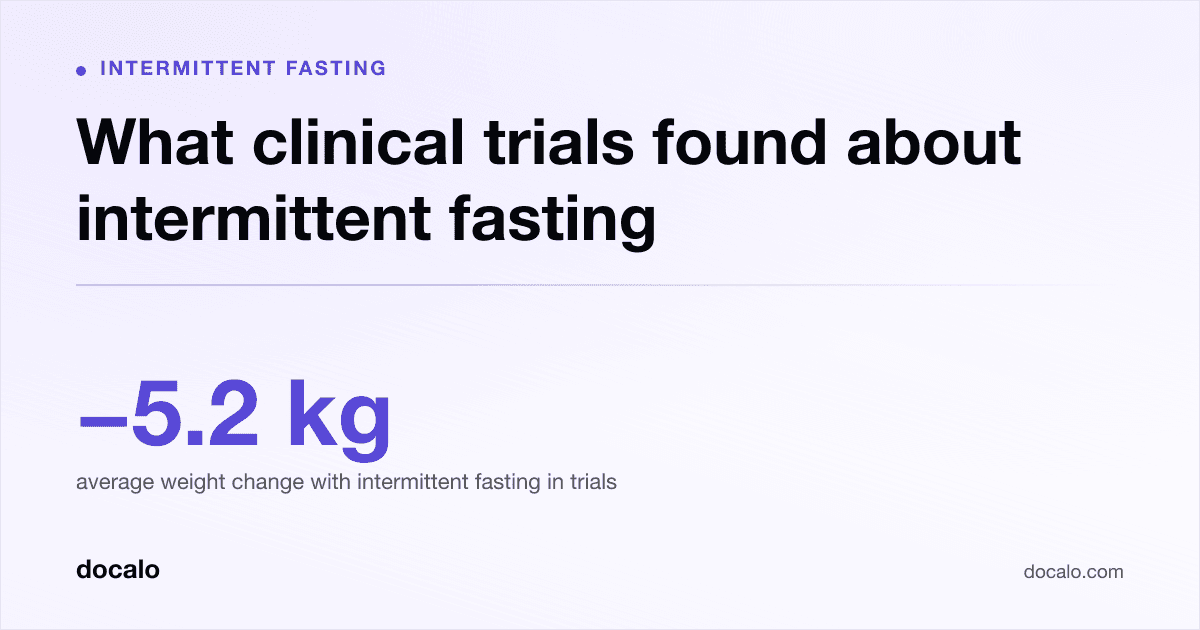
Many clinical trials have shown that intermittent fasting can be an effective strategy for modest weight loss. The amount of weight lost is often comparable to that achieved through traditional daily calorie restriction. For example:
- Systematic reviews and meta-analyses comparing IF to continuous energy restriction (CER) often find similar weight loss outcomes over periods ranging from 2 to 12 months. This suggests that IF is not necessarily superior to traditional dieting for weight loss, but it can be an equally viable alternative for some individuals.
- Studies on time-restricted eating (e.g., 16/8) have shown participants losing 3-5% of their body weight over 8-12 weeks. This is often attributed to a spontaneous reduction in overall calorie intake, as participants naturally eat less when their eating window is restricted.
- Research on alternate-day fasting has also demonstrated weight loss, with some studies reporting losses of 3-8% of body weight over 3-6 months. However, adherence can be challenging for some individuals due to the intensity of the fasting days.
It's important to note that the primary driver of weight loss in most IF protocols is a reduction in overall calorie intake. Whether this reduction comes from restricting when you eat or what you eat, a calorie deficit is generally required for weight loss.
Metabolic Health Benefits Beyond Weight Loss
Beyond its impact on body weight, intermittent fasting has been investigated for its potential effects on various markers of metabolic health:
- Insulin Sensitivity: Several studies suggest that IF can improve insulin sensitivity, which is beneficial for managing blood sugar levels and reducing the risk of type 2 diabetes. This improvement is often observed even independently of significant weight loss.
- Blood Pressure: Some research indicates that IF may lead to modest reductions in blood pressure, potentially contributing to cardiovascular health.
- Cholesterol Levels: While findings are mixed, some studies have reported improvements in lipid profiles, such as reductions in LDL (bad) cholesterol and triglycerides.
- Inflammation: Preliminary research suggests IF might have anti-inflammatory effects, which could have broad health implications.
These metabolic benefits are promising, but more long-term, large-scale studies are needed to fully understand the extent and durability of these effects in diverse populations.
Potential Downsides and Considerations
While IF offers potential benefits, it's not without its challenges and considerations:
- Adherence: Some individuals find it difficult to stick to IF protocols long-term due to hunger, fatigue, or social eating challenges.
- Side Effects: Common initial side effects can include hunger, headaches, irritability, and difficulty concentrating. These often subside as the body adapts.
- Nutrient Adequacy: If not carefully planned, restricting eating windows could lead to inadequate intake of essential nutrients. It's crucial to ensure that meals consumed during the eating window are nutrient-dense and balanced.
- Muscle Loss: While most studies show IF can preserve muscle mass better than some traditional diets, there's always a risk of muscle loss with any weight loss strategy if protein intake and physical activity are insufficient.
- Specific Populations: Intermittent fasting is generally not recommended for pregnant or breastfeeding individuals, those with a history of eating disorders, individuals with type 1 diabetes, or those on certain medications that require food intake (e.g., to prevent hypoglycemia). Children and adolescents should also avoid IF.
Is Intermittent Fasting Right for You?
The decision to consider intermittent fasting should always be made in consultation with a healthcare professional. While research supports its potential for weight loss and metabolic improvements, individual responses can vary significantly, and a doctor can help determine if it's appropriate for your specific health situation.
Before considering IF, a doctor would typically evaluate:
- Lifestyle Compatibility: Can a fasting schedule realistically fit into your daily routine, work, and social life without causing undue stress or negative impacts?
- Health Status: Do you have any underlying health conditions or are you taking medications that might be affected by fasting? Certain conditions or medications may make IF unsuitable or even dangerous.
- Sustainability: Is this an eating pattern you could maintain long-term, or would it feel overly restrictive and unsustainable for you?
For many, the simplicity of IF – focusing on when to eat rather than complex food rules – can be appealing and easier to adhere to than traditional diets. However, it's not a magic bullet. The quality of food consumed during the eating window remains paramount for overall health and sustained results.
Ultimately, the most effective weight management strategy is one that you can adhere to consistently over time, that promotes overall health, and that is tailored to your individual needs and circumstances, as determined by a healthcare professional.
How Docalo can help
Navigating the world of diet and weight management can be complex. At Docalo, we understand that making informed decisions about your health is crucial. Our telehealth service connects you with licensed doctors who can provide personalised guidance and support.
If you're considering intermittent fasting or any other dietary change for weight management, a Docalo doctor can help you assess if it's appropriate for your individual health profile. They can discuss the potential benefits and risks, taking into account your medical history, current medications, and lifestyle. Our doctors can also help you develop a safe and sustainable plan, monitor your progress, and address any concerns that may arise.
For just EUR49 a month, a Docalo membership includes clinician review, care-team messaging, progress tracking, refill support, and pharmacy coordination. A licensed doctor will decide if treatment is appropriate for you. If the doctor determines that treatment is not suitable, you will receive a full refund.
Docalo membership is EUR49/month with ongoing medical review. If the doctor decides treatment is not appropriate, you receive a full refund.
Consult DocaloCOMMON QUESTIONS
Frequently asked questions
Intermittent fasting (IF) is an eating pattern that cycles between periods of voluntary fasting and non-fasting. It focuses on when you eat rather than what you eat, aiming to give your body extended periods without food to shift its metabolic state.