Weight loss
Resistance Training for Weight Loss: Why It's Crucial
Discover the vital role of resistance training in weight loss, preserving muscle, boosting metabolism, and improving body composition.
Aug 7, 2026
DIRECT ANSWER
An online consultation lets an EU-licensed doctor review your case and, if appropriate, issue a prescription that is valid across the EU.
Less than 4 hours on average
Prescription issued in less than 4 hours on average if approved.
EU-licensed doctors
Every case is reviewed by a licensed clinician.
Valid across the EU
Approved prescriptions can be used at any EU pharmacy.
In this article
HOW IT WORKS
From consultation to collection
- 1
Step 1
Consultation
Answer a secure medical questionnaire online.
- 2
Step 2
Doctor reviews
An EU-licensed doctor personally assesses your case.
- 3
Step 3
Prescription in less than 4 hours on average
If approved, your prescription is issued in less than 4 hours on average.
- 4
Step 4
Collect at any EU pharmacy
Use an approved prescription at a pharmacy anywhere in the EU.
### Key Takeaways Preserves Muscle Mass: Resistance training helps maintain muscle during weight loss, which is crucial for a healthy metabolism. Boosts Metabolism: More muscle means a higher resting metabolic rate, helping you burn more calories even at rest. Improves Body Composition: It helps reshape your body by reducing fat and increasing lean mass, leading to a more toned appearance. Enhances Overall Health: Beyond weight, it strengthens bones, improves insulin sensitivity, and boosts mood. * Sustainable Results: Incorporating resistance training makes weight loss more sustainable and helps prevent weight regain.
A licensed doctor reviews your questionnaire and decides if treatment is appropriate for you.
Start consultationEmbarking on a weight loss journey often brings to mind images of calorie counting and endless hours on a treadmill. While diet and cardiovascular exercise are undoubtedly important, one crucial component is often overlooked: resistance training while losing weight. This type of exercise, which includes activities like lifting weights, using resistance bands, or even bodyweight exercises, plays a pivotal role not just in shedding kilos, but in transforming your body composition and improving your overall health in profound ways.
Understanding why resistance training is so beneficial can empower you to make more informed choices about your fitness routine, leading to more effective and sustainable results. Let's delve into the science and practical benefits.
The Challenge of Weight Loss: More Than Just the Scale
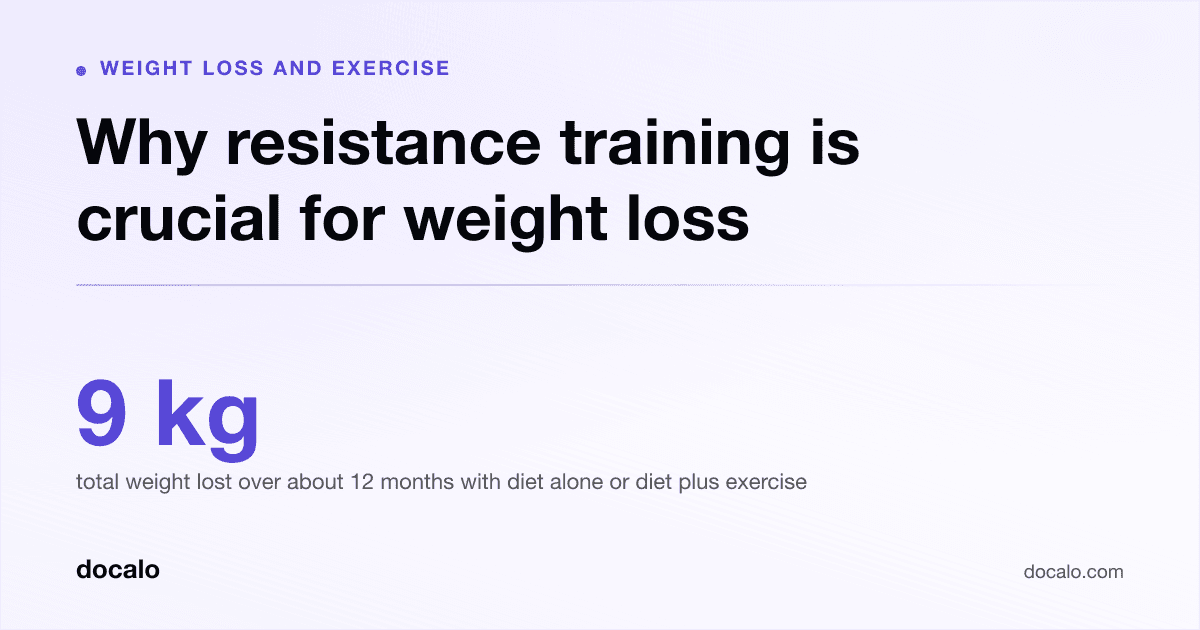
When you lose weight, your body doesn't always discriminate between fat and muscle. A significant portion of weight lost through diet alone, or even with only cardiovascular exercise, can come from muscle mass. This muscle loss can have several undesirable consequences:
- Slower Metabolism: Muscle is metabolically active tissue, meaning it burns more calories at rest than fat. Losing muscle can slow down your resting metabolic rate (RMR), making it harder to continue losing weight and easier to regain it.
- Weakness and Fatigue: Reduced muscle mass can lead to decreased strength and energy levels, impacting daily activities.
- Flabby Appearance: Even if the number on the scale goes down, a loss of muscle can result in a less toned physique.
This is where resistance training steps in as a game-changer.
How Resistance Training Transforms Your Weight Loss Journey
1. Preserving and Building Muscle Mass
The primary benefit of incorporating resistance training during weight loss is its ability to preserve existing muscle mass and, in some cases, even build new muscle. When you challenge your muscles, you signal to your body that this tissue is important and should be retained, even in a calorie deficit. This is critical for maintaining a healthy metabolism and strength.
2. Boosting Your Metabolism
As mentioned, muscle is more metabolically active than fat. By preserving or increasing your muscle mass through resistance training, you effectively turn your body into a more efficient calorie-burning machine. This means you'll burn more calories throughout the day, even when you're not exercising. This metabolic boost is a significant advantage for long-term weight management, helping to counteract the natural metabolic slowdown that can occur during weight loss.
3. Improving Body Composition and Aesthetics
Weight loss isn't just about the number on the scale; it's about changing your body composition – the ratio of fat to lean mass. Resistance training excels at this. By reducing fat and increasing muscle, you can achieve a more toned, sculpted, and firm appearance. You might even find your clothes fit better, even if the scale doesn't show a dramatic change, because muscle takes up less space than fat.
4. Enhancing Bone Density and Joint Health
Resistance training isn't just good for muscles; it also puts healthy stress on your bones, stimulating them to become denser and stronger. This is particularly important as we age and for individuals at risk of osteoporosis. Stronger muscles also provide better support for your joints, potentially reducing the risk of injury and improving overall mobility.
5. Better Blood Sugar Control
Muscles play a vital role in glucose uptake and insulin sensitivity. Regular resistance training can improve how your body uses insulin, helping to regulate blood sugar levels. This is beneficial for overall metabolic health and can be particularly important for individuals managing or at risk of type 2 diabetes.
6. Mental Well-being and Confidence
The benefits of resistance training extend beyond the physical. The sense of accomplishment from lifting heavier weights or performing more repetitions can significantly boost self-esteem and confidence. Exercise, in general, is known to release endorphins, which can improve mood, reduce stress, and alleviate symptoms of anxiety and depression. Seeing your body become stronger and more capable can be incredibly motivating and empowering.
Integrating Resistance Training into Your Routine
If you're new to resistance training, it's wise to start slowly and gradually increase intensity. Here are some general guidelines:
- Frequency: Aim for 2-3 resistance training sessions per week, allowing at least one day of rest between sessions for muscle recovery.
- Types of Exercises: Focus on compound movements that work multiple muscle groups simultaneously, such as squats, deadlifts (or Romanian deadlifts), lunges, push-ups, rows, and overhead presses. Bodyweight exercises are an excellent starting point.
- Sets and Reps: For general strength and muscle preservation, 2-4 sets of 8-12 repetitions per exercise are often recommended. The key is to choose a weight or resistance level that makes the last few repetitions challenging but allows you to maintain good form.
- Progression: To continue seeing results, you need to progressively challenge your muscles. This can involve increasing the weight, doing more repetitions, adding more sets, or decreasing rest time between sets.
- Form Over Weight: Always prioritize proper form to prevent injuries. If you're unsure, consider watching instructional videos or seeking guidance from a qualified fitness professional.
Remember that resistance training complements, rather than replaces, a balanced diet and cardiovascular exercise. For optimal weight loss and health, a holistic approach is most effective.
How Docalo can help
Docalo offers a comprehensive approach to health and weight management, connecting you with licensed doctors who can provide personalized guidance. For just EUR49/month, a Docalo membership includes clinician review, care-team messaging, progress tracking, refill support, and pharmacy coordination. If medication is prescribed, it is paid separately at the pharmacy. Our doctors can help you understand how resistance training fits into a broader, medically supervised plan, ensuring it aligns with your health profile and goals. A licensed doctor will decide if treatment is appropriate for you. If the doctor determines that treatment is not suitable, you will receive a full refund.
Docalo membership is EUR49/month with ongoing medical review. If the doctor decides treatment is not appropriate, you receive a full refund.
Consult DocaloCOMMON QUESTIONS
Frequently asked questions
Not necessarily. While heavy lifting can be effective, you can achieve significant benefits with moderate weights, resistance bands, or even bodyweight exercises, especially when starting out. The key is progressive overload – gradually increasing the challenge over time.