Weight loss
Fatty Liver Disease and Weight: How Losing Weight Reverses It
Explore the strong link between excess weight and fatty liver disease (NAFLD). Understand the mechanisms and practical steps for better liver health.
Aug 7, 2026
DIRECT ANSWER
An online consultation lets an EU-licensed doctor review your case and, if appropriate, issue a prescription that is valid across the EU.
Less than 4 hours on average
Prescription issued in less than 4 hours on average if approved.
EU-licensed doctors
Every case is reviewed by a licensed clinician.
Valid across the EU
Approved prescriptions can be used at any EU pharmacy.
In this article
HOW IT WORKS
From consultation to collection
- 1
Step 1
Consultation
Answer a secure medical questionnaire online.
- 2
Step 2
Doctor reviews
An EU-licensed doctor personally assesses your case.
- 3
Step 3
Prescription in less than 4 hours on average
If approved, your prescription is issued in less than 4 hours on average.
- 4
Step 4
Collect at any EU pharmacy
Use an approved prescription at a pharmacy anywhere in the EU.
### Key Takeaways Fatty liver disease, specifically non-alcoholic fatty liver disease (NAFLD), is strongly linked to excess body weight and obesity. Losing even a modest amount of weight can significantly reduce fat in the liver, improve inflammation, and prevent disease progression. Sustainable lifestyle changes, including a balanced diet and regular physical activity, are the cornerstone of managing and reversing NAFLD. Early intervention is crucial, as untreated NAFLD can lead to more severe liver conditions like non-alcoholic steatohepatitis (NASH), fibrosis, and cirrhosis. * Docalo offers support for individuals looking to manage their weight and improve their overall health, with licensed doctors determining appropriate treatment paths.
A licensed doctor reviews your questionnaire and decides if treatment is appropriate for you.
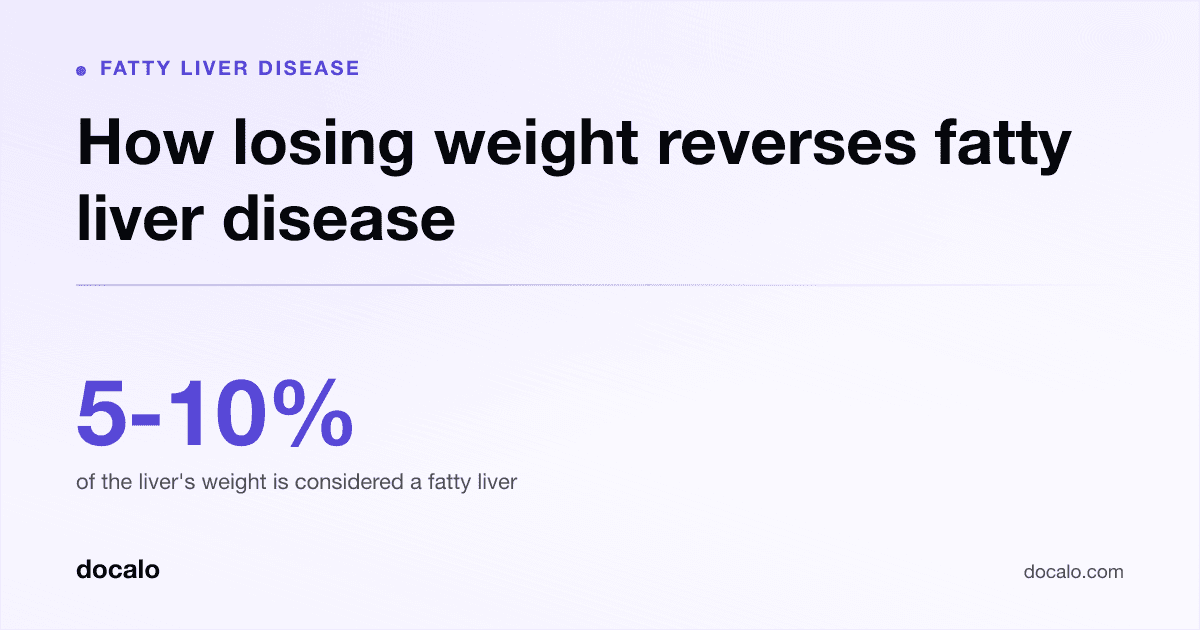
Start consultationFatty liver disease, medically known as hepatic steatosis, is a condition characterised by the accumulation of excess fat in the liver cells. While it's normal for the liver to contain some fat, if fat makes up more than 5-10% of the liver's weight, it's considered a fatty liver. The most common form of this condition in Europe and globally is non-alcoholic fatty liver disease (NAFLD), which is not caused by heavy alcohol consumption.
NAFLD is increasingly prevalent, mirroring the rise in obesity rates. It's often referred to as a silent disease because it typically presents with no symptoms in its early stages. However, if left unmanaged, NAFLD can progress to more serious forms of liver damage, including inflammation (non-alcoholic steatohepatitis or NASH), scarring (fibrosis), and eventually irreversible liver damage (cirrhosis) or even liver cancer. Understanding the strong connection between fatty liver disease and weight is crucial for effective management and prevention.
The Link Between Weight and Fatty Liver Disease
Excess body weight, particularly abdominal obesity (fat around the waist), is a primary risk factor for developing NAFLD. The mechanisms linking obesity to fat accumulation in the liver are complex but well-established:
Insulin Resistance
Obesity often leads to insulin resistance, a condition where the body's cells don't respond effectively to insulin. Insulin is a hormone that helps regulate blood sugar. When cells become resistant, the pancreas produces more insulin to compensate. High insulin levels can promote fat storage in the liver and reduce the liver's ability to process and remove fat.
Increased Fat Delivery to the Liver
Individuals with obesity tend to have higher levels of free fatty acids circulating in their bloodstream. These fatty acids are taken up by the liver, where they are converted into triglycerides and stored as fat. The liver becomes overwhelmed by the influx of fat, leading to its accumulation.
Inflammation and Oxidative Stress
Adipose tissue (body fat), especially visceral fat, is not just a storage site; it's an active endocrine organ that releases inflammatory molecules. These molecules can travel to the liver, contributing to inflammation and oxidative stress. Chronic inflammation in the liver is a key factor in the progression from simple fatty liver to more severe forms like NASH.
Genetic Predisposition
While lifestyle factors are dominant, some genetic predispositions can increase an individual's susceptibility to NAFLD, especially when combined with obesity. These genetic factors can influence how the body stores and processes fat, making some people more prone to liver fat accumulation.
How Weight Loss Reverses Fatty Liver Disease
The good news is that NAFLD is often reversible, especially in its earlier stages, and weight loss is the most effective intervention. Even modest weight loss can have a significant positive impact on liver health.
Reduction in Liver Fat
Studies consistently show that losing even 3-5% of body weight can lead to a significant reduction in liver fat. This reduction is often the first and most immediate benefit of weight loss for individuals with NAFLD. As the body uses stored fat for energy, the liver's fat content decreases.
Improved Insulin Sensitivity
Weight loss, particularly a reduction in visceral fat, improves insulin sensitivity. When cells become more responsive to insulin, blood sugar levels stabilise, and the pancreas produces less insulin. This reduces the signal for the liver to store fat and enhances its ability to process existing fat.
Decreased Inflammation and Fibrosis
Losing weight helps reduce systemic inflammation. As inflammatory molecules released by adipose tissue decrease, the liver experiences less inflammatory stress. This can halt or even reverse the progression of inflammation (NASH) and prevent the development of fibrosis (scarring). For individuals with existing fibrosis, weight loss can sometimes lead to its regression.
Better Liver Enzyme Levels
Elevated liver enzymes (such as ALT and AST) are often indicators of liver damage. Weight loss typically leads to a normalisation of these enzyme levels, reflecting improved liver function and reduced cellular damage.
Overall Metabolic Health Improvement
Beyond the liver, weight loss improves overall metabolic health, including blood pressure, cholesterol levels, and blood sugar control. These systemic improvements further support liver health and reduce the risk of other obesity-related complications.
Practical Steps for Sustainable Weight Loss
Achieving sustainable weight loss requires a holistic approach focused on long-term lifestyle changes rather than quick fixes.
Dietary Modifications
- Reduce processed foods and added sugars: These contribute significantly to calorie intake and liver fat accumulation. Focus on whole, unprocessed foods.
- Increase fibre intake: Foods rich in fibre, such as fruits, vegetables, and whole grains, promote satiety, aid digestion, and help regulate blood sugar.
- Choose healthy fats: Opt for monounsaturated and polyunsaturated fats found in avocados, nuts, seeds, and olive oil, while limiting saturated and trans fats.
- Portion control: Be mindful of portion sizes to manage overall calorie intake.
- Limit sugary drinks and alcohol: These can contribute to liver fat and inflammation.
Regular Physical Activity
- Aim for at least 150 minutes of moderate-intensity aerobic activity per week: This could include brisk walking, cycling, swimming, or dancing.
- Incorporate strength training: Building muscle mass can boost metabolism and improve insulin sensitivity.
- Reduce sedentary time: Break up long periods of sitting with short walks or stretches.
Behavioural Changes and Support
- Set realistic goals: Gradual, sustainable weight loss (0.5-1 kg per week) is more effective and healthier than rapid weight loss.
- Monitor progress: Keep a food diary, track physical activity, and regularly weigh yourself to stay accountable.
- Seek support: Engage with healthcare professionals, support groups, or family and friends for encouragement and guidance.
- Manage stress and ensure adequate sleep: Chronic stress and poor sleep can impact hormones that regulate appetite and metabolism.
The Importance of Early Intervention
Given the silent nature of early NAFLD, many individuals are unaware they have the condition until it has progressed. However, early detection and intervention are critical. If you have risk factors such as obesity, type 2 diabetes, high cholesterol, or high blood pressure, it's advisable to discuss liver health with a healthcare professional. A doctor can assess your risk, conduct necessary tests (such as blood tests for liver enzymes or imaging scans), and guide you on appropriate management strategies.
Remember, the goal is not just to lose weight, but to adopt a healthier lifestyle that supports long-term liver health and overall well-being. The liver has a remarkable capacity for regeneration, and by making positive changes, you can significantly improve its condition and prevent severe complications.
How Docalo can help
Docalo offers a comprehensive membership designed to support individuals on their weight management journey. For EUR49 per month, members receive ongoing clinical support, including regular check-ins with a care team, progress tracking tools, and assistance with medication refills and pharmacy coordination. A licensed doctor will review your health profile and determine if treatment is appropriate for you. If a doctor decides that treatment is not suitable, you will receive a full refund. Please note that while the membership covers clinical support, any prescribed medication is paid separately at the pharmacy.
A licensed doctor reviews every consultation and decides if treatment is appropriate for your individual situation — nothing is ever prescribed automatically.
Docalo membership is EUR49/month with ongoing medical review. If the doctor decides treatment is not appropriate, you receive a full refund.
Consult DocaloCOMMON QUESTIONS
Frequently asked questions
Fatty liver disease, or hepatic steatosis, is a condition where too much fat builds up in the liver cells. If it's not caused by heavy alcohol use, it's called non-alcoholic fatty liver disease (NAFLD).