Diet10 minute read
Eating out while losing weight: a practical guide for restaurants and social meals
Restaurant meals often hold far more energy than meals at home, but you do not have to stop going out. Practical ways to order, share and enjoy menús, tapas, pizza and social events.
DIRECT ANSWER
An online consultation lets an EU-licensed doctor review your case and, if appropriate, issue a prescription that is valid across the EU.
Doctor reply in under 2 hours
Average doctor reply under 2 hours; prescription within 24 hours if approved.
EU-licensed doctors
Every case is reviewed by a licensed clinician.
Valid across the EU
Approved prescriptions can be used at any EU pharmacy.
Key takeaways - A study of major UK restaurant chains found that most main meals contained well over 600 kcal, and full-service restaurant meals averaged around 1,000 kcal. - A systematic review linked eating out with higher energy and fat intake and lower intake of some vitamins and minerals. - People reliably eat more when portions are larger, so sharing, ordering starters as mains and leaving food on the plate all help. - Building the meal around vegetables and a protein, and choosing how you handle bread, dessert and alcohol in advance, matters more than any single rule. - Eating out is part of normal life. One meal will not undo your progress; the pattern over weeks is what counts.
Docalo pairs you with a licensed doctor who reviews your health and builds a weight plan with you.
Meals out are one of the pleasures of life in Europe: a weekday menú del día, tapas with friends, a family pizza night, a wedding that lasts until midnight. When you are trying to lose weight, they can also feel like a minefield.
This guide explains why restaurant food tends to be so high in energy, then gives practical, realistic ways to order and enjoy meals out without feeling that you have to choose between your social life and your health.
Why restaurant meals add up
Portions are large
Researchers looking at the energy content of main meals at UK restaurant chains analysed more than 13,000 menu items. Full-service restaurant meals averaged around 1,000 kcal, more than fast-food meals, and the large majority exceeded the 600 kcal per main meal suggested in UK public health advice. That was before starters, sides, drinks or dessert.
The study was done in the UK, but the pattern will be familiar to anyone who has eaten out elsewhere in Europe. Generous portions, rich sauces, added oil and bread on the table are standard in many restaurants.
Eating out is linked with eating more
A systematic review of eating out of home found that meals eaten away from home were associated with higher total energy and fat intake and lower intake of some micronutrients. The studies were observational, so they cannot prove cause, but the direction was consistent.
We eat what we are served
A Cochrane review of portion and tableware size found consistent evidence that people eat more when offered larger portions, packages or plates. That is not a personal weakness. It is how human appetite responds to the food in front of us.
Before you go
A small amount of planning reduces the number of decisions you have to make at the table, when you are hungry and the bread has already arrived.
- Look at the menu online and choose a dish in advance.
- Do not arrive starving. Skipping lunch to "save up" for dinner often leads to eating more. Have your usual meals and, if needed, a small snack with protein, such as yoghurt or a handful of nuts, an hour before.
- Decide your approach to the extras: bread, alcohol and dessert. Pick one, two or none, depending on the occasion, so you are not deciding on the spot.
- Keep your weekly total in mind. If you know you have a celebration on Saturday, a lighter Friday and a walk on Sunday morning balance it out. The calorie deficit calculator gives a rough daily target, which you can think of as a weekly budget too.
Ordering strategies that work
Build the plate around protein and vegetables
Protein is the most filling of the main nutrients. A review of protein and weight management found that higher-protein meals tend to reduce hunger and later intake. Vegetables and salads add volume and fibre for few calories. Together they make a meal satisfying without needing a large portion of starch or fat. Our guides to protein and appetite and dietary fibre and fullness explain why.
Simple swaps on almost any menu
- Grilled, baked or steamed (a la plancha, al horno, al vapor) instead of fried, battered or in creamy sauces.
- Salad or vegetables as a side instead of chips, or ask for half and half.
- Sauces and dressings on the side, so you choose how much to use.
- A starter as your main, or a starter plus a side salad, when portions are large.
- Water on the table, and a glass before you start eating.
Practical choices by setting
| Setting | Lighter choices | Things that add up quickly | Useful tactics |
|---|---|---|---|
| Menú del día | Salad, gazpacho, grilled vegetables or legume stew to start; grilled fish or chicken as the main | Fried starters, chips with everything, bread, dessert and wine all included | Choose a vegetable first course; ask for salad instead of chips; take fruit or coffee as the dessert option |
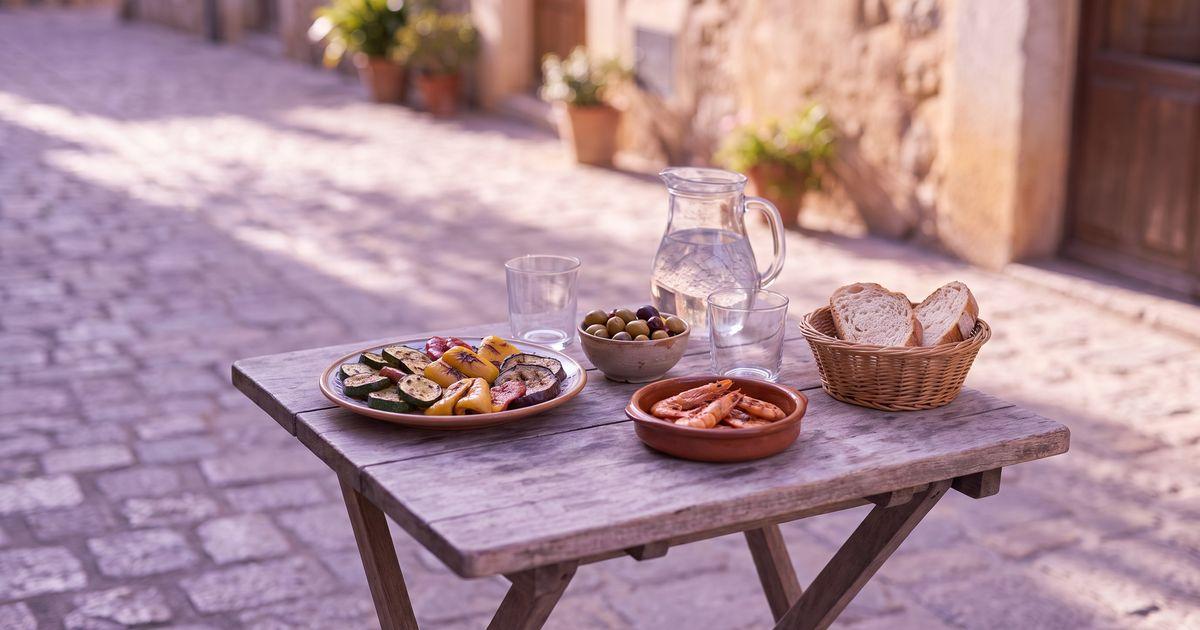
| Tapas | Grilled prawns, octopus, pimientos de padrón, mussels, salads, jamón, olives in small amounts | Croquetas, patatas bravas, fried calamari, cheese boards, lots of bread | Order a few dishes at a time; start with vegetable and seafood plates; eat slowly between rounds |
| Pizza and pasta | Thin-base pizza with vegetables and a lean topping; tomato-based pasta; a side salad | Extra cheese, salami or chorizo toppings, cream sauces, garlic bread | Share a pizza and a large salad; order a starter-sized pasta |
| Burgers and fast food | Single patty, grilled chicken, side salad, water | Doubles, bacon, large fries, sugary drinks, milkshakes | Choose the smallest size; skip the meal deal upgrade |
| Asian restaurants | Steamed dishes, broth-based soups, sashimi, stir-fried vegetables with lean protein | Tempura, fried rice, sweet sauces, large noodle portions | Share several dishes; have plain rice in a smaller portion |
| Weddings and big events | Canapés with vegetables or seafood, the main course, water between drinks | Repeated canapé rounds, bread, multiple desserts, late-night snacks | Eat a normal meal earlier in the day; hold a glass of water; dance |
None of these are rules. They are options. If the croquetas are the reason you came, have them and enjoy them, then build the rest of the meal around lighter dishes.
Alcohol and eating out
Drinks are often the biggest unplanned source of energy in a meal out. A large glass of wine can contain well over 100 kcal, and two or three cañas of beer add up quickly. Alcohol also lowers your guard around food, so it tends to bring extra bread, tapas and dessert with it.
A review of alcohol and obesity found that light-to-moderate drinking was generally not linked with weight gain in recent prospective studies, while heavy drinking was more consistently linked with it. The WHO Regional Office for Europe is also clear that no level of alcohol is safe for health, so drinking less benefits you beyond weight.
Practical options:
- Alternate each alcoholic drink with water or sparkling water.
- Choose a smaller measure, such as a caña or a small glass of wine.
- Try alcohol-free beer or a tinto de verano made with alcohol-free wine.
- Decide in advance how many drinks you will have.
Our article on alcohol and weight loss covers calories in common drinks and how alcohol affects appetite.
At the table
- Slow down. Fullness signals take around 15 to 20 minutes to build. Putting your fork down between bites and talking more helps.
- Leave food on the plate if you are full. Taking leftovers home is normal in many places.
- Share dessert, or choose fruit, a coffee or a small sorbet.
- Notice the bread. If you want it, have one piece with your meal rather than eating from the basket while you wait.
- Be kind to yourself. If a meal is bigger than planned, go back to your usual pattern at the next meal. There is no need to compensate by skipping food the next day.
Handling social pressure
Comments like "just have one more" or "you are on a diet again?" can be harder than the food itself. A few short, friendly phrases help: "I'm full, thanks, it was delicious", or "I'm pacing myself tonight". You do not owe anyone an explanation about your weight or health.
If eating out is part of your job, or you eat out most days, it is worth treating it as your regular eating pattern rather than an exception. Choosing two or three go-to orders at places you visit often removes a lot of daily decision-making. Our guide to ultra-processed food and overeating has more ideas on making the easy choice the default.
How Docalo can help
Docalo is an online medical service focused only on weight loss. Your €49/month membership covers a doctor consultation, a personal plan and follow-up with the medical team, including strategies that fit your social life, work and family meals.
A licensed doctor reviews your health questionnaire and decides whether treatment is appropriate for you. If they prescribe medication, it is paid separately at the pharmacy. If you want a plan that works in the real world, menús and celebrations included, you can start your consultation.
One Docalo membership covers the doctor assessment, a personal plan, monthly follow-up and messaging. Medication, if prescribed, is paid separately at the pharmacy.
COMMON QUESTIONS
Frequently asked questions
Yes. Weight loss depends on your overall pattern over weeks and months, not on a single meal. Planning ahead, building your plate around protein and vegetables, and deciding in advance how you will handle bread, alcohol and dessert let you enjoy meals out and keep making progress.
References
- Robinson E et al. (Over)eating out at major UK restaurant chains: observational study of energy content of main meals. BMJ 2018;363:k4982.
- Lachat C et al. Eating out of home and its association with dietary intake: a systematic review. Obes Rev 2012;13:329-46.
- Hollands GJ et al. Portion, package or tableware size for changing selection and consumption of food, alcohol and tobacco. Cochrane Database Syst Rev 2015.
- Traversy G, Chaput JP. Alcohol consumption and obesity: an update. Curr Obes Rep 2015;4:122-30.
- WHO Regional Office for Europe. No level of alcohol consumption is safe for our health. 2023.
- Leidy HJ et al. The role of protein in weight loss and maintenance. Am J Clin Nutr 2015;101:1320S-1329S.